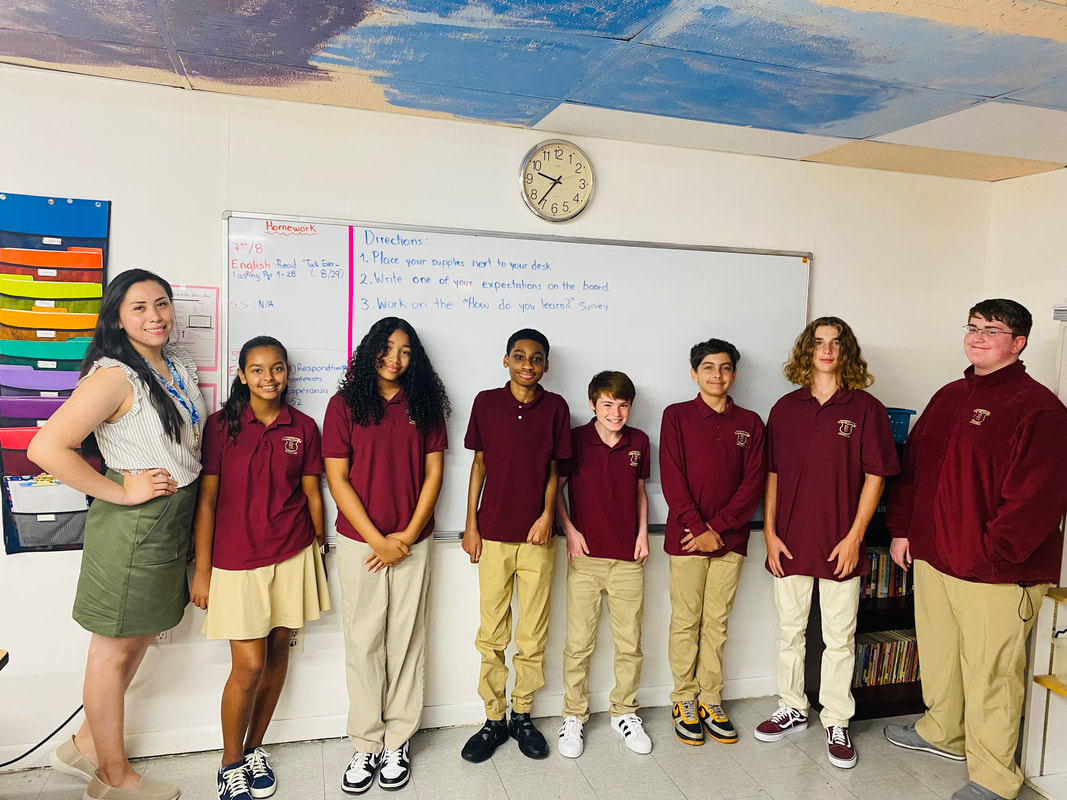
Middle School English & Social Studies
Middle School English and Social Studies Curriculum
English Grades 5-8 Reading Students will read a variety of grade-level complex text with accuracy, automaticity, appropriate rate, and meaningful expression in successive readings to support comprehension. They will monitor while reading to confirm or self-correct word recognition and understanding when necessary. They will respond to text through discussion and/or writing, draw on several pieces of evidence from grade-level complex texts to support claims, conclusions, and inferences, including quoting or paraphrasing from texts accurately and tracing where relevant evidence is located. Vocabulary Students will regularly engage in reading a series of conceptually related texts organized around topics of study to build knowledge and vocabulary. Students will apply knowledge of Greek and Latin roots and affixes to predict the meaning of unfamiliar words. They will use the relationship between particular words, including synonyms, antonyms, and analogies to better understand each word. Students will analyze the construction and meaning of figurative language, including simile, hyperbole, metaphor, and personification. Students will use newly learned words and phrases in multiple contexts, including in students’ discussions and speaking and writing activities. Writing Students will write narratives to develop real or imagined experiences or to alter an existing text, using a variety of precise words and phrases and transitional words to develop the characters, convey sequence, and signal shifts from one timeframe or setting to another. They will write expository texts to examine a topic or concept that develops the focus with relevant facts, definitions, concrete details, or other information from multiple credible sources, using structures and patterns (e.g., description, enumeration, classification, comparison, problem-solution, or cause-effect) to clarify relationships among ideas. They will write persuasively supporting a well-defined point of view with appropriate claims, relevant evidence, and clear reasoning that are logically grouped. They will write reflectively in response to reading to demonstrate thinking with details, examples, and other evidence from the text(s). Research Students will formulate questions about a research topic, broadening or narrowing the inquiry as necessary. They will collect, organize, and synthesize information from multiple sources using various notetaking formats. They will evaluate and analyze the relevance, validity, and credibility of each source (primary, secondary, digital, and print), determining what information to include and exclude. Students will quote, summarize, and paraphrase research findings from primary and secondary sources, avoiding plagiarism by using own words and following ethical and legal guidelines. They will give credit for information quoted or paraphrased, using standard citations (e.g., author, article title and webpage, and publication date). Middle School Social Studies United States History Students will use skills for historical and geographical analysis to explore the early history of the United States and understand ideas and events that strengthened the union. The standards for this course relate to the history of the United States from pre-Columbian times until the present. Students will continue to learn fundamental concepts in civics, economics, and geography as they study United States history in chronological sequence and learn about change and continuity in our history. They also will study documents and speeches that laid the foundation for American ideals and institutions and will examine the everyday life of people at different times in the country’s history through the use of primary and secondary sources. World History Students will explore the historical development of people, places, and patterns of life from ancient times until the present. The study of history rests on knowledge of dates, names, places, events, and ideas. Historical understanding, however, requires students to engage in historical thinking, raise questions, and marshal evidence in support of their answers. Students engaged in historical thinking draw upon chronological thinking, historical comprehension, historical analysis and interpretation, historical research, and decision making. These skills are developed through the study of significant historical substance from the era or society being studied. Attention will be given to political boundaries that developed with the evolution of nations. Significant attention will be given to the ways in which scientific and technological revolutions created new economic conditions that in turn produced social and political changes. Geography & Global Issues Students will study the world’s peoples, places, and environments, with an emphasis on world regions. The knowledge, skills, and perspectives of the course are centered on the world’s peoples and their cultural characteristics, landforms and climates, economic development, and migration and settlement patterns. Spatial concepts of geography will be used as a framework for studying interactions between humans and their environments. Using geographic resources, students will employ inquiry, research, and technology skills to ask and answer geographic questions. Geographic skills provide the necessary tools and technologies for thinking geographically. Maps, as well as graphs, sketches, diagrams, photographs, and satellite-produced images, are essential tools of geography. Civics and Economics Students will examine the roles citizens play in the political, governmental, and economic systems in the United States. They will examine the foundational documents and principles with which the constitutions of Virginia and the United States were established, identify the rights, duties, and responsibilities of citizens, and describe the structure and operation of government at the local, state, and national levels. Through the economics standards, students will compare the United States economy to other types of economies and consider the government’s role in the United States economy. Students will investigate the process by which decisions are made in the American market economy and explain the government’s role in the United States economy. The standards identify personal character traits, such as patriotism, respect for the law, willingness to perform public service, and a sense of civic duty, that facilitate thoughtful and effective active participation in the civic life of an increasingly diverse democratic society.
| ||||||||||||||